
Help shape the updated ITIL Practices

PUBLIC REVIEW | 25 November – 6 December 2026

Your perspective can help shape the next evolution of the ITIL Practices. Review the proposed updates to the five Practices within ITIL Monitor, Support and Fulfil (Version 5), and tell us whether the guidance reflects today’s ways of working and provides practical direction for responsible AI use.
Welcome to ITIL (Version 5)
Everything has changed since the 1980s, when the first version of ITIL was released by the UK government’s Central Computer and Telecommunications Agency (CCTA). Since then, ITIL has evolved for more than four decades in response to the changing needs of the world it serves, shaped by the commitment and contributions of people and organizations across the globe.
Through this global community, ITIL has remained the Global Best Practice framework across its successive focus areas – from its early roots in ICT, through IT Service Management and Digital Transformation, to Service Management, and now building on its heritage to expand to meet the needs of every professional and organization in the AI era.

ITIL, the language of growth, provides a common language to ensure alignment and collaboration, enabling teams to move end-to-end as one, unlocking value and driving growth with clarity and speed. AI-native by design. Practical to apply, from day one. Human-centric, because AI delivers value only when people use it with confidence.

Understanding the ITIL Practices
What are the ITIL Practices?
Professionals and organizations often face disconnected ways of working, unclear responsibilities and competing priorities. ITIL Practices provide practical guidance for bringing together the people, processes, information, technology and partners needed to achieve specific objectives and improve outcomes from digital products and services.
Each of the 34 Practices addresses a particular organizational need. Together, they help professionals strengthen their expertise and organizations develop the capabilities needed to deliver better experiences, manage risks and continually improve.

The Practices explain how work connects across teams, clarifiy responsibilities and provide ways to measure performance and to assess and develop practice capability over time.
Why do we need 34 Practices?
Managing digital products and services requires a broad range of capabilities, from understanding stakeholder needs and managing suppliers to resolving incidents and enabling change. The 34 ITIL Practices address distinct but connected management objectives across this work. Organizations can use the guidance to strengthen the capabilities most relevant to their priorities, bringing Practices together within value streams to achieve better outcomes.

The Practices provide a shared basis for deciding what needs to happen, who is responsible, which resources are required and whether the work achieves its intended outcome. Teams can adapt the guidance to their circumstances and use it to identify gaps in their current approach.

AI and automation make effective management of these capabilities increasingly important. As technology takes on more tasks and supports more decisions, organisations still need clear accountability, appropriate oversight and controls for risk. ITIL (Version 5) connects these requirements with the management of digital products and services, helping organisations adopt AI responsibly and keep business outcomes in focus.

ITIL Practices: grouping and certification
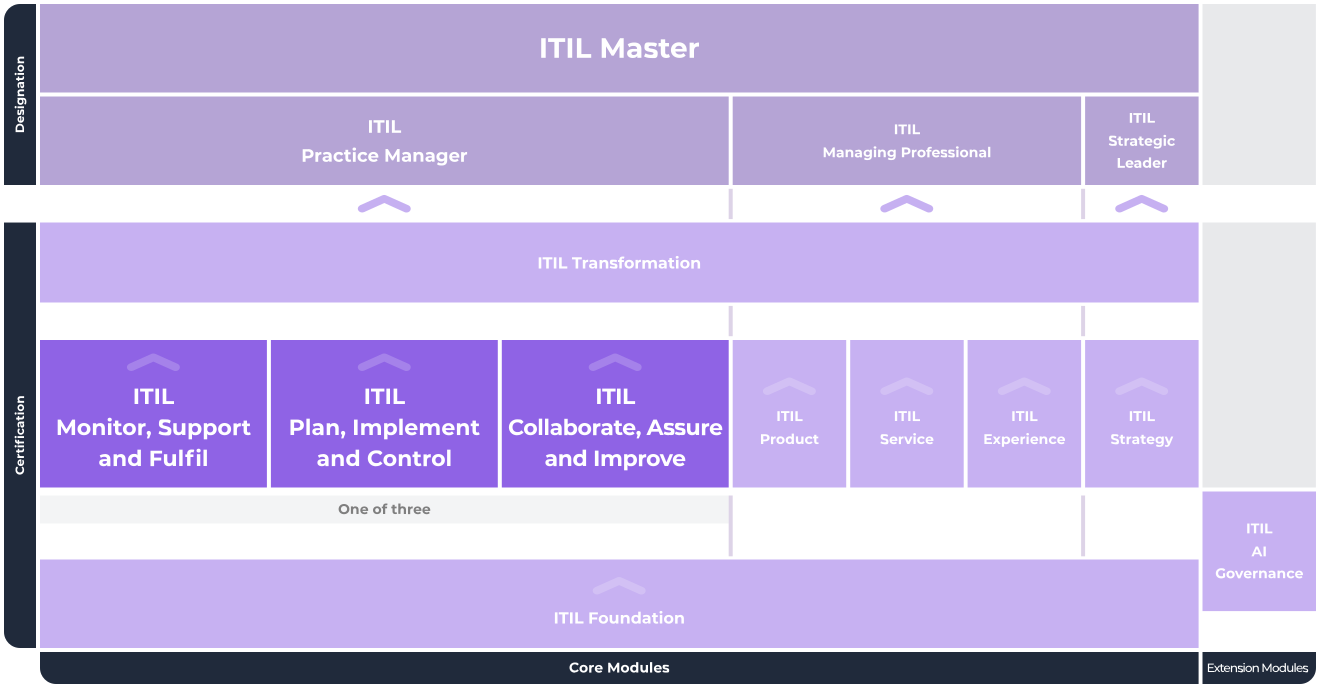
ITIL Qualification Scheme-Practice Manager-Path
Fifteen ITIL Practices are grouped into three practice certifications, each covering five complementary Practices.
These groupings help professionals understand how related Practices work together and adopt the guidance across teams.
Each certification is planned to include an open-book, scenario-based multiple-choice exam, with a recommended course duration of three days for instructor-led training.
How the grouping works in each certification
Connects operational monitoring with user support, service restoration, request fulfilment and the prevention of recurring incidents. Helps professionals coordinate these activities to reduce disruption and improve user's experience. Practices covered
  • Incident Management
  • Monitoring and Event Management
  • Problem Management
  • Service Desk
  • Service Request Management
Connects decisions about change with the information and activities needed to implement it successfully. Helps professionals assess risk, understand dependencies and coordinate changes to digital products and services. Practices covered
  • Change Enablement
  • Deployment Management
  • Release Management
  • Service Configuration Management
  • IT Asset Management
Connects stakeholder expectations and supplier contributions with service performance, information security and improvement. Helps professionals establish shared priorities, evaluate outcomes and coordinate improvements that support business needs. Practices covered
  • Relationship Management
  • Supplier Management
  • Service Level Management
  • Continual Improvement
  • Information Security Management.

The updates to the Practices are intended to align guidance with ITIL (Version 5), extend its coverage across digital products and services, and introduce targeted AI guidance. They build on existing Practice content rather than replacing every established way of working. The remaining 19 Practices will continue as individual Official Practice Guides outside these certification groupings and will follow a separate update and publication schedule.

The Practices under review and the roles relevant to them
First for review are the five updated Official Practice Guides covered in the ITIL Monitor, Support and Fulfil (Version 5) certification. These Practices are developed to be practical and useful in everyday work for a range of roles.
Practitioners and operational roles
Incident managers
Major incident managers
Service desk managers
Service desk agents
Problem managers/coordinators
Service owners
Product owners
Resource owners
Technical and fulfilment specialists
Observability specialists, where established
Related and supporting roles
Suppliers and supplier/service integration roles
Risk and compliance managers
Solution designers
ITSM tool consultants
Information / Cyber security specialists
Capacity and availability managers
Service continuity managers
Leaders and Practice stakeholders
CIOs, CTOs and other senior leaders
Heads of Product, Service and Quality
Practice owners/managers
Operational and service management leaders
About the review

AI is changing how teams detect issues, support users, fulfil requests and investigate recurring incidents. Your feedback will help us assess whether the proposed updates are relevant to ways of working in the AI era and address the needs of professionals and organizations.

What you will review

To keep the review quick and focused, you will see the following for each of the five Practices:
• Its purpose, scope and relevance
• What has changed from ITIL 4
• A summary of the Practice-specific AI guidance
• A chapter-by-chapter view of what the Practice Guide covers

Please note: These are concise summaries, not the full Practice Guides.

What to consider

As you review, please consider:
• The overall direction of the guidance
• Its relevance to your work
• How realistically its AI guidance could be applied in your role and organization


Your contribution matters
  • Help ensure the updated ITIL guidance reflects real-world needs.
  • Be recognized for your contribution to the public review.
  • Be considered for future ITIL Practices (Version 5) beta opportunities.

  The review closes on 6 December 2026.