Develop strategies that connect vision to measurable outcomes.
ITIL Strategy (Version 5) provides practical guidance to develop, deliver, and sustain strategies that create lasting value.
It aligns technology, investment, and execution with business outcomes, enabling organizations to act with clarity and confidence in complex, AI-driven environments.
Why It Matters
Organizations today operate in environments defined by uncertainty, rapid change, and increasing reliance on digital and AI-enabled capabilities. Without a clear strategy, investments can become disconnected from outcomes, limiting value realization.
ITIL Strategy (Version 5) addresses this by focusing on: Aligning technology and investment with business strategy Supporting confident decision-making in complex environments Connecting strategy with execution and measurable outcomes Enabling long-term value creation and organizational resilience
Core Focus
ITIL Strategy (Version 5) focuses on the development and execution of effective strategies across modern organizations. It includes:
Alignment of technology, investment, and business outcomes
Strategy development and implementation cycles
Decision-making in complex and uncertain environments
Integration of governance, risk, and sustainability into strategy
Application of AI governance in strategic decision-making
Leadership, communication, and innovation as strategic capabilities
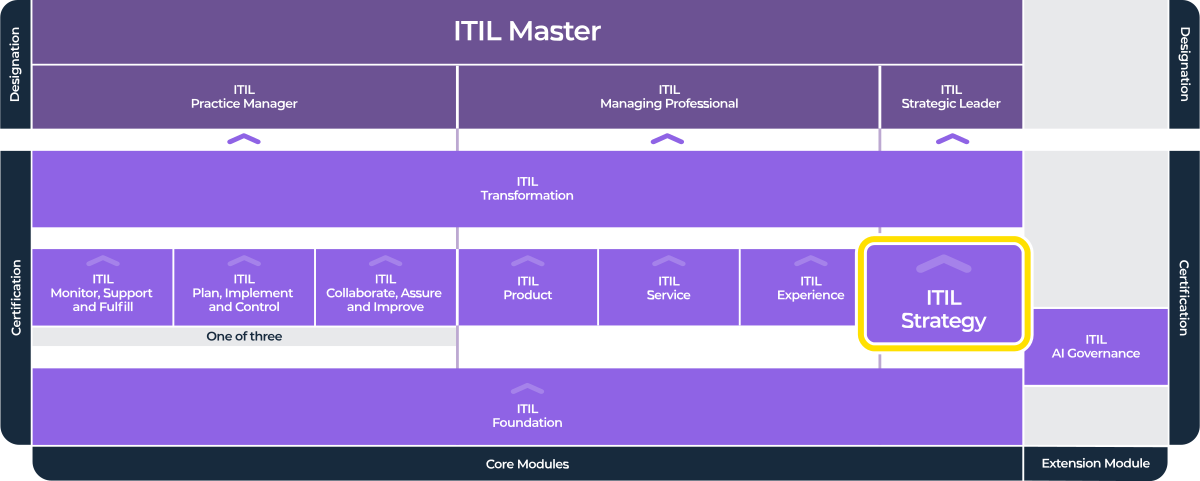
How It Fits Within the ΙTIL Qualification Scheme
ITIL Strategy (Version 5) is part of the ITIL Strategic Leader designation, designed for professionals responsible for setting direction and driving organizational value.
Completion of ITIL Strategy (Version 5), together with ITIL Transformation (Version 5) and ITIL Foundation (Version 5), leads to the ITIL Strategic Leader designation.
This pathway validates the ability to align strategy with execution and deliver measurable outcomes in modern digital environments.
Where This Capability Adds Value
ITIL Strategy (Version 5) supports organizations operating in complex, fast-changing environments where technology, investment, and business priorities must remain aligned. It enables:
Alignment of strategy with execution and measurable outcomes
Supporting confident decision-making in complex environments
Connecting strategy with execution and measurable outcomes
Enabling long-term value creation and organizational resilience