
Organizational Maturity and Performance
Evidence from the ITIL Performance Benchmarking Survey
The relationship between organizational maturity and business performance is widely assumed but rarely demonstrated. Based on data from the 2026 ITIL Performance Benchmarking Survey, this paper shows that organizations with higher maturity consistently deliver stronger performance. The findings suggest that leaders should systematically assess organizational maturity, identify improvement opportunities and measure the resulting business outcomes.
Maturity and Performance
Capability maturity is a measure of an organization’s ability to deliver predictable results despite changing conditions. It reflects the extent to which practices, governance, skills, measurement and improvement mechanisms are established and consistently applied. It provides leaders with assurance that organizational performance is aligned with business priorities and based on repeatable capabilities rather than individual effort or good fortune.
Capability maturity, however, does not directly measure performance. A mature organization is expected to perform consistently, but maturity alone does not indicate whether those capabilities translate into better business outcomes.
ITIL provides the ITIL Maturity Model and the ITIL Performance Benchmarking Model for assessing organizational maturity and performance. Together, these models help organizations understand where they are today, prioritize improvement initiatives and track their progress over time. The findings below illustrate the relationship between organizational maturity and performance.
Key Findings
The findings presented in this paper are based on data from the ITIL Performance Benchmarking Survey, which was conducted in 2026. In total, 720 organizations of all sizes, industries and geographic regions participated in the survey.
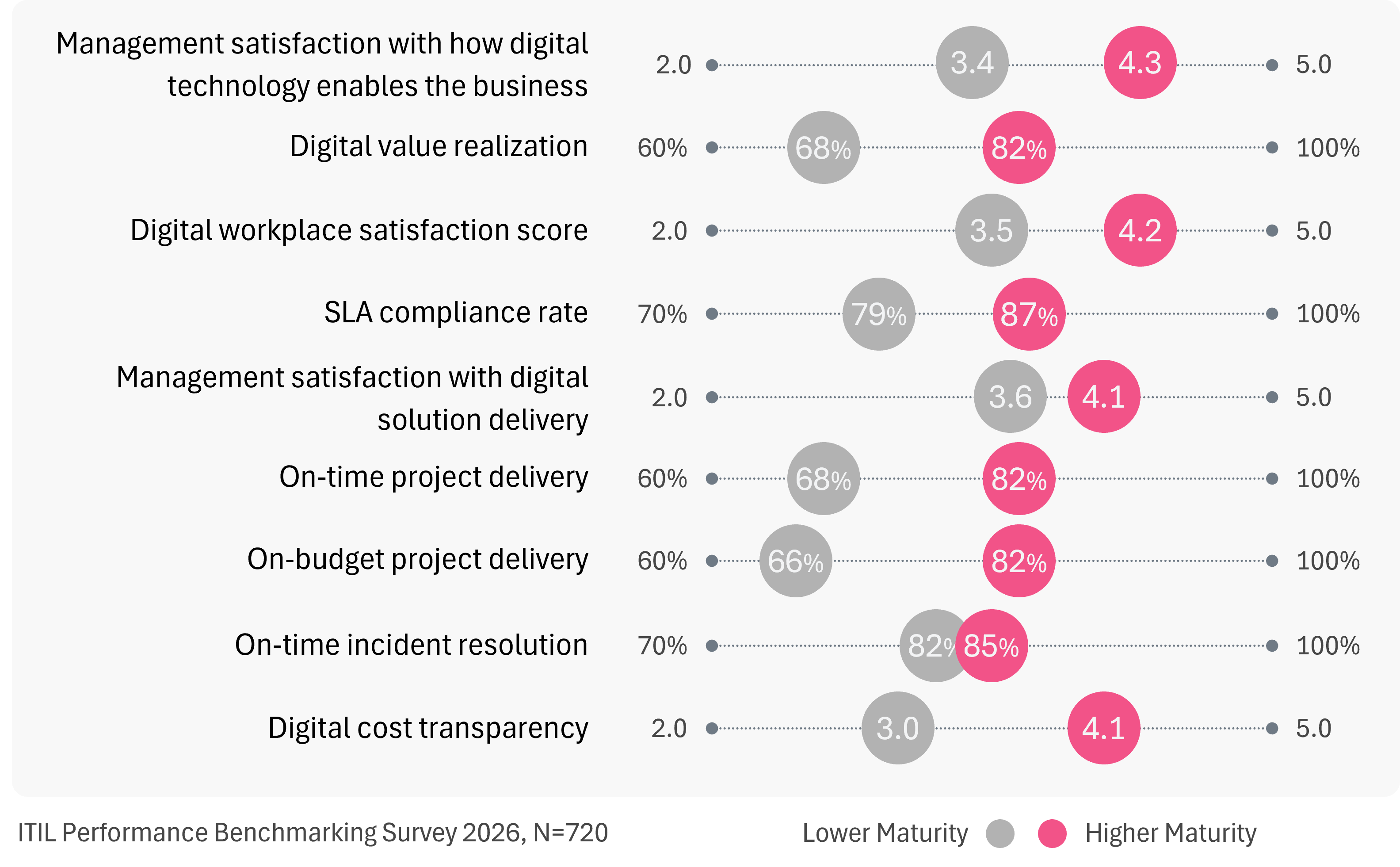
Across the survey sample, higher organizational maturity is consistently associated with higher performance for all analyzed metrics. For each metric, the higher-maturity group has a higher average, and the distribution of results is shifted towards higher-performing values.
The analyzed metrics represent two complementary approaches to measuring organizational performance. Some metrics assess performance directly through operational data, while others capture management and user perceptions of the outcomes delivered by digital technology. The consistent relationship observed across both types of measures suggests that higher organizational maturity is associated not only with improved operational performance but also with greater stakeholder confidence in digital technology.
Conclusion
For organizational leaders, the findings reinforce the importance of systematically assessing management capability, identifying improvement opportunities and measuring the resulting business outcomes. ITIL provides a globally recognized framework for assessing and improving management capability in the digital product and service management domain. Maturity assessment and performance benchmarking enable leaders not only to understand where they are today, but also to make informed investment decisions, prioritize improvement initiatives and demonstrate the business value of management capability over time.

 Find an Accredited Consulting Partner to help you assess and improve your organization’s maturity level.